• Skip to primary navigation
  • Skip to main content

← cbs.dk

CBS logo

nordicesglab

  • Blog
  • Research & Resources
    • Governing Nordic ESG
      • EXECUTIVE REMUNERATION AMONG DANISH C25 COMPANIES
    • Blue Nordic ESG
      • Wind Energy and Marine Ecosystems
      • Building on Evolving Standards to Develop Robust Ocean-Related Metrics
      • From the Investor Survey to action: building insights for the development of blue metrics
    • Green Nordic ESG
  • Teaching
  • Events
  • About Us
  • Contact
  • Show Search
Hide Search

vap.msc@cbs.dk

From Compliance to Resilience: How can companies prioritize material sustainability topics to enhance organizational resilience? 

vap.msc@cbs.dk · 17/07/2025 ·

By Prof. Kristjan Jespersen,  Justus Claudius Ernst and Áron Radványi

Today’s global environment is increasingly volatile, uncertain, complex, and ambiguous (VUCA). This heightened uncertainty underlines the importance of organizational resilience—how companies prepare for and respond to adverse events. Frequent crises in the 21st century highlight severe consequences when disruptions occur in our fragile and interconnected socioeconomic systems. Companies have a dual responsibility: minimize their contributions to disruptions and mitigate their impacts on their own operations. 

The Corporate Sustainability Reporting Directive (CSRD) mandates companies to perform Double Materiality Assessments (DMA). These assessments help identify and report impacts, risks, and opportunities (IRO) related to sustainability. Additionally, CSRD requires businesses to disclose how resilient their strategies and business models are. Despite these regulations, many companies lack a clear method for integrating DMA into resilience-focused strategies. 

DMA as a Strategic Learning Loop 

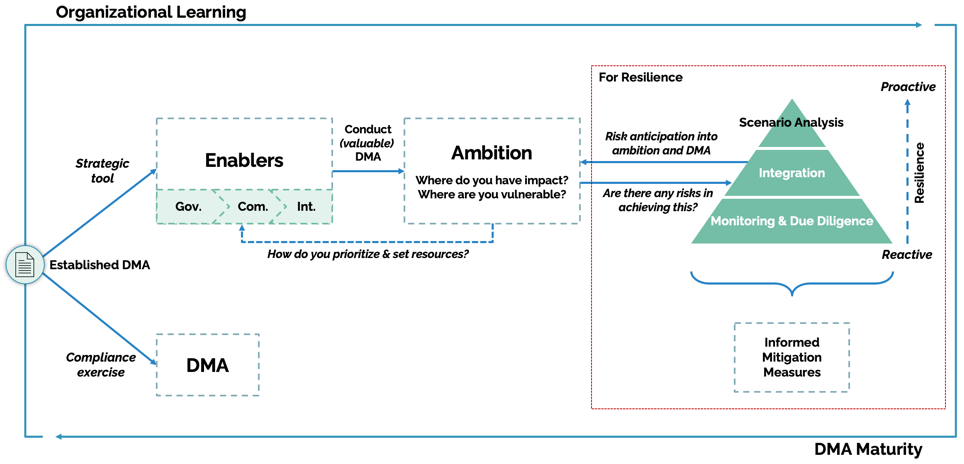
Our research found that DMA, when used strategically, becomes more than a mere reporting requirement—it transforms into a catalyst for continuous learning, innovation, and resilience. Our findings are based on 15 semi-structured interviews with representatives from 13 C25 companies and two sustainability advisory firms. Using a resource-based view and the dynamic capabilities framework, we analyzed the data to understand DMA’s strategic potential for organizational resilience. 

Instead of a one-off annual exercise, strategically applied DMA creates a continuous learning loop. Regularly reassessing environmental, social, and governance (ESG) issues and stakeholder concerns leads to ongoing improvements. Each assessment cycle provides insights that inform decision-making, helping companies adapt proactively to emerging sustainability trends and stakeholder expectations. This process institutionalizes a habit of learning and adaptability within organizations. 

DMA as a Strategic Knowledge Asset 

Insights gained through DMA become strategic intangible assets. By understanding stakeholder priorities, environmental risks, and social impacts deeply, companies generate knowledge that fulfills the VRIO criteria: 

  • Valuable: Helps identify and mitigate risks. 
  • Rare: Unique due to specialized DMA methods. 
  • Inimitable: Built on unique stakeholder relationships and proprietary data. 
  • Organized: Fully integrated into the company’s operational systems. 

These insights provide competitive advantages. Sustainability practitioners can leverage DMA to generate proprietary intelligence, such as early identification of environmental risks or emerging consumer concerns ahead of competitors. 

DMA Enhancing Dynamic Capabilities 

Treating DMA strategically strengthens a company’s dynamic capabilities—its ability to adapt rapidly to change. Our study found that firms deeply engaged with DMA: 

  • Enhance their sensing abilities by scanning continuously for risks and opportunities. 
  • Improve their seizing capabilities by integrating DMA insights into business operations. 
  • Strengthen their transforming abilities by adjusting operations or products based on new sustainability insights. 

Companies that approach ESG as merely a compliance checklist often lack the agility required to respond to new challenges. Conversely, those strategically leveraging DMA foster cross-departmental collaboration and innovation, increasing their overall resilience. 

The Integrated DMA Ecosystem 

Embedding DMA into core corporate processes further enhances organizational resilience. Instead of being confined to sustainability teams or annual reports, DMA becomes integrated into broader corporate strategy, risk management, governance, and stakeholder engagement. This holistic integration ensures organization-wide alignment in monitoring and responding to ESG issues, enabling proactive identification and mitigation of risks. 

For example, early detection of supply chain vulnerabilities or community concerns through DMA prompts preemptive actions, cushioning potential crises. A proactive approach involving cross-functional workshops, regular updates to the materiality matrix, and executive goals linked to sustainability outcomes transforms companies from reactive to proactive entities. 

Conclusion 

Strategically embracing DMA shifts the focus from mere compliance to building long-term organizational resilience. Integrating DMA into business strategy and routine learning enables companies not just to meet regulatory requirements but also to proactively anticipate and adapt to sustainability challenges. This resilience-focused approach ultimately unlocks sustained competitive advantages in an increasingly volatile world. 

About the Authors 

Prof. Kristjan Jespersen is an Associate Professor in Sustainable Innovation and Entrepreneurship at the Copenhagen Business School (CBS). Kristjan is an Associate Professor at the Copenhagen Business School (CBS). As a primary area of focus, he studies the growing development and management of Ecosystem Services in developing countries. Within the field, Kristjan focuses his attention on the institutional legitimacy of such initiatives and the overall compensation tools used to ensure compliance. He has a background in International Relations and Economics.  

Justus Ernst recently completed a Master’s degree in Accounting, Strategy and Control at Copenhagen Business School (CBS), alongside a CEMS Master’s in International Management. During his studies, he worked at Jabra, focusing on pricing and commercial excellence. In September, he will join Valcon as a Graduate Management Consultant.

The Influence of Geopolitical Risk on Sustainable Investments: How sustainable investors navigate an increasingly uncertain geopolitical landscape

vap.msc@cbs.dk · 16/07/2025 ·

By Prof. Kristjan Jespersen, Oda Solend and Anna Sophia Burri

In today’s global landscape, geopolitical risk (GPR) is rising in both frequency and intensity. War in Ukraine, rising U.S.-China tensions, trade disruptions, resurgent nationalism, and mounting global uncertainty all challenge the stability of investment environments. For investors, this creates a turbulent decision-making climate. At the same time, sustainable investments are becoming a central tool in the global response to climate change. Recognized by both policymakers and markets, they help redirect capital toward renewable energy, green infrastructure, and ethical developments. Investment into sustainable assets has grown exponentially, from $13.3 trillion in 2012 to over $30 trillion by 2022, with forecasts pointing to $40 trillion by 2030. But what happens to these investments when geopolitical instability rises?
This tension between growing climate urgency and increasing geopolitical volatility builds the starting point of our master thesis. Existing research primarily explores their relationship through quantitative models, focusing on market volatility or asset prices. A crucial gap, however, remains: How do sustainable investors assess GPRs? And how does this influence their investment decisions? That’s what we set out to explore.


How We Studied It
To unpack how GPR influences sustainable investments, we conducted a three-part qualitative study:

  • GPR Mapping: We developed a comprehensive typology of 63 specific GPRs, organized into three overarching categories: geography, politics, and macroeconomics. This mapping helped us ground the study and design the next stages.
  • Scenario-Based Workshop: We facilitated a workshop with six sustainable investors, using a geopolitical scenario to explore real-world sensemaking and decision-making processes.
  • In-Depth Interviews: We conducted interviews with five sustainable investors and three geostrategic consultants to deepen our understanding of the internal and external dynamics shaping investment decisions.

What We Found
Our findings show that GPR influences sustainable investments in two key ways: through material disruptions and investor interpretations.
Investors increasingly see GPR as a structural and unavoidable factor in investment processes and decision-making. GPR shapes not just which investments are made, but how they are assessed, managed, and adapted over time. In many cases, decisions are influenced by perceived threats as much as actual events. We found that GPR influences decisions both before and after capital is committed. Prior to investment, GPR can act as a hard stop or shift strategic focus toward lower-risk regions. After commitment, especially in illiquid assets like infrastructure, investors adapt through ongoing monitoring, stakeholder engagement, or scenario planning.


However, the way investors respond to GPR is highly context-dependent. Some firms rely on informal, individual-level assessments, while others have formalized internal structures and public affairs teams. Organizational structures, exclusion criteria, previous experiences, informal norms, and external mandates all shape how investors interpret and act on GPR.


In other words, GPR influences both the rationale and the reality of sustainable investing, and it does so in ways that are filtered through both institutional pressures and personal judgment.

Interpreting Complexity: Our Contribution
By combining two theoretical perspectives – neo-institutional theory and sensemaking theory – we were able to connect the dots between organizational structure and individual interpretation shaping GPR assessments of sustainable investments.


Our thesis contributes to the underexplored literature on GPR and sustainable investing by showing how investors interpret, assess, and respond to geopolitical events in a world of growing complexity. Instead of treating geopolitics and geoeconomics as separate, we show how investors perceive macroeconomic and political threats as intertwined.

We also highlight the limits of quantification: GPR doesn’t always lend itself to measurable indicators. Its ambiguity requires judgment, narrative framing, and forward-looking models. Our study shows how qualitative inputs, like scenario planning, expert insight, and internal considerations, are crucial to making sense of geopolitical uncertainty.


By combining insights from both organizational structures and individual sensemaking, our thesis answers recent academic calls to bridge the macro and micro levels of analysis.
Together, these lenses allowed us to offer qualitative insights into the “how” behind GPR assessment and decision-making – complementing the dominant focus on quantitative research in this field.

What Sustainable Investors Can Do
In practice, sustainable investors should:

  • Actively monitor GPR, both through one-off assessments and ongoing tracking.
  • Use scenario analysis to explore potential future developments and translate qualitative inputs into quantitative investment impacts, thereby increasing both awareness and preparedness.
  • Develop internal structures for coordination between investment teams and risk experts.
  • Embrace nuance: GPR is interpretive, contextual, and messy. Trying to reduce it to a single metric can be misleading.
  • Identify strategic opportunities: GPR can open up space for leadership and long-term impact. Turning uncertainty into advantage is a hallmark of resilient investing.

Final Thought
In an era where the world is heating up – geopolitically and environmentally – GPR returns as a top concern among sustainable investors. They need frameworks to understand, tools to adapt, and strategies to act amid uncertainty. This thesis is our small step toward helping sustainable investors navigate that uncertain future.

About the Authors 

Prof. Kristjan Jespersen is an Associate Professor in Sustainable Innovation and Entrepreneurship at the Copenhagen Business School (CBS). Kristjan is an Associate Professor at the Copenhagen Business School (CBS). As a primary area of focus, he studies the growing development and management of Ecosystem Services in developing countries. Within the field, Kristjan focuses his attention on the institutional legitimacy of such initiatives and the overall compensation tools used to ensure compliance. He has a background in International Relations and Economics.  
Oda Solend recently completed her Master’s degree in International Business and Politics at Copenhagen Business School (CBS), with a minor in ESG. She will join KPMG as a Risk and Regulatory Consultant in August. Previously, she worked at Novo Nordisk, supporting innovation initiatives in the life science ecosystem, and volunteered with femella, a network organization dedicated to empowering female students and young professionals in their careers and personal development.

Incorporating circularity metrics into investment decision-making results in comparable financial outcomes while simultaneously enhancing risk mitigation 

vap.msc@cbs.dk · 16/07/2025 ·

By Prof. Kristjan Jespersen, Cecilie Duch and Nathalie Fichte

In an era marked by accelerating ecological degradation and increasing demand for sustainable economic models, the field of sustainable finance is experiencing a paradigm shift. While CO2 emissions have long dominated environmental metrics in investment decisions, this focus captures only a small part of the sustainability agenda. While important, this narrow focus captures only a fraction of the sustainability agenda. Integrating circular economy (CE) principles offers a broader and more regenerative framework, complementing carbon metrics with deeper insights into material flows, resource efficiency, and long-term system resilience.  

The inclusion of circularity into portfolio design 

The global economy remains largely entrenched in a linear ‘take-make-waste’ paradigm, wherein resource extraction and waste generation proceed with minimal regard for ecological thresholds. This cradle-to-grave model has propelled humanity toward multiple breached planetary boundaries (Rockström et al., 2023). The ‘Limits to Growth’ report (Club of Rome, 1972) warned already over fifty years ago of the environmental consequences of indefinite economic expansion. Today, its predictions are no longer hypothetical.  

In response, the circular economy proposes a fundamental shift in economic logic—from throughput maximization to regenerative value creation. Circularity emphasizes design for durability, reuse, repairability, and closed-loop systems, aiming to decouple growth from environmental harm. Embedding these principles into investment logic may reshape how capital allocation drives systemic change. 

Development of the Circular Investment Tool (CIT) 

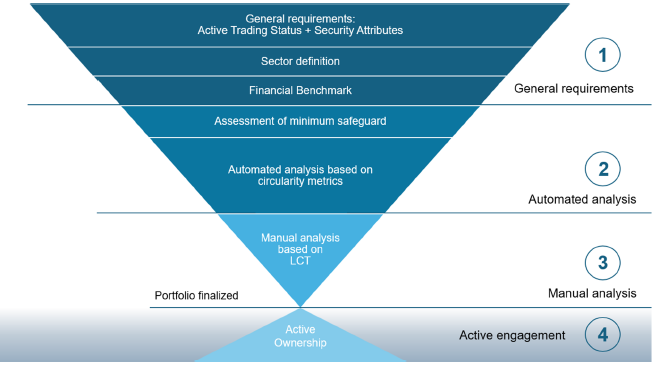
To effectively integrate circularity metrics into portfolio design, a framework for investment screening in the following called CIT was developed. This framework blends automated data analysis with manual review, enabling a more complete and nuanced assessment based on publicly available information.  

The CIT is designed to integrate seamlessly into investment workflows and includes four key phases: 

  1. General Requirements: Includes sector definitions, financial benchmarks, and minimum ESG thresholds. 
  1. Automated Analysis: Uses publicly available data to assess indicators such as material circularity, product lifespan, and design-for-disassembly. 
  1. Manual Review: Addresses gaps in automated data through qualitative evaluation of transition narratives and disclosures. 
  1. Active Ownership: Encourages investor engagement with portfolio companies to foster long-term improvements in circularity performance. 

This integrated approach bridges the gap between data-driven screening and investor stewardship, enhancing both rigor and strategic influence. 

Main Findings 

The findings present both challenges and opportunities for integrating circularity into sustainable finance: 

  • Lack of Standardization 

A recurring theme was a conceptual ambiguity around circularity, as different practitioners interpreted it in varying ways. There is currently no standardized or universally accepted approach to assessing circularity in investments, which makes its scalability more difficult. 

  • Proxy Reliance 

GHG emissions remain the default proxy for sustainability, overshadowing the complexities of assessing and defining nature and how it is affected by human-led business activities. 

  • Challenges around data quality and availability 

Other prominent challenges were the quality and availability of sustainability and specifically circularity data provided by companies. This was highlighted as an issue limiting integration into portfolio design. 

  • Proof of Concept – CIT in Practice  

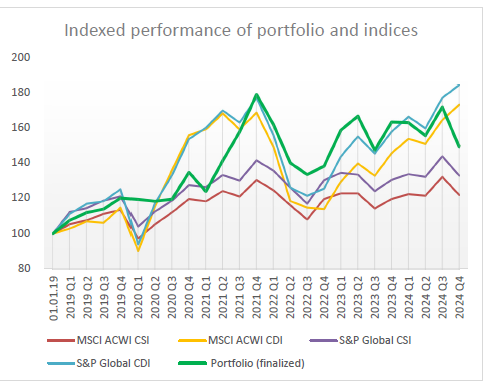
Applying the CIT, we constructed a portfolio of 39 consumer goods companies and benchmarked it against sector-specific indices. The circular portfolio achieved comparable financial performance relative to traditional benchmarks but demonstrated greater resilience during periods of market volatility. This suggests that circularity metrics may bolster risk-adjusted returns and improve foresight in capital allocation. 

  • Alternatives of the CIT 

The discussion of the research elaborates on potential adaptations of the CIT, including the expansion of the manual analysis in regard to its feasibility and added value, the third-party verification of data and its impact on reliability, transparency, and data quality and availability, and the aspect of active engagement 

Implications and Future Research 

The conducted research explores the reasons behind the absence of a standardized understanding of circularity within the investment landscape, suggesting that this may be partly due to the concept’s relative immaturity. It also highlights the growing relevance and potential influence of circularity in a world marked by geopolitical uncertainty and complex challenges. In addition, the research examines the composition of the designed portfolio, which leans more towards companies demonstrating transitional circular potential rather than incorporating companies with fully circular business models. This underscores the significance of corporate initiatives and forward-looking commitments in advancing circularity. 

While the study focused on the consumer goods sector, the CIT was designed with cross-sector applicability in mind. Sectoral expansion should be guided by materiality considerations. Promising applications include construction, industrial manufacturing, and agriculture, where resource intensity and environmental impact are significant. 

Integrating circularity into investment decision-making does not compromise financial outcomes. On the contrary, it offers a pathway to enhanced risk mitigation, portfolio resilience, and alignment with long-term sustainability goals. As data quality improves and circular economy principles become institutionalized, tools like the CIT will be essential in shaping the next generation of sustainable investing. 

About the Authors 

Prof. Kristjan Jespersen is an Associate Professor in Sustainable Innovation and Entrepreneurship at the Copenhagen Business School (CBS). Kristjan is an Associate Professor at the Copenhagen Business School (CBS). As a primary area of focus, he studies the growing development and management of Ecosystem Services in developing countries. Within the field, Kristjan focuses his attention on the institutional legitimacy of such initiatives and the overall compensation tools used to ensure compliance. He has a background in International Relations and Economics.  

Cecilie Duch has a HD in business administration and accounting, alongside a Cand.merc in strategy, organization and leadership topped with a minor in ESG from Copenhagen business school (CBS). She has a lead role as a sustainability auditor and consultant. She consults on topics such as ESG, VSME and CSRD reporting, internal sustainability controlling environments and audits of annual sustainability reports. Academically she focuses on sustainability in the business sphere spanning reporting, integration, and responsible investments.

Nathalie Fichte recently completed a MSc in Strategy, Organization, and Leadership with a Minor in Environment, Social, and Governance (ESG) at Copenhagen Business School (CBS). She was working in sustainability consulting and assurance and has prior experience in the area of international development cooperation. This August, she will be continuing working within the field of ESG through joining the department of Management, Society, and Communication at the center for sustainability at CBS as a research assistant. Her academic interest spans from circular economy, ESG reporting, to sustainable finance topics.

Strategic ESG Alignment in Danish Banking: The Case of Nykredit’s Sustainability Commitments 

vap.msc@cbs.dk · 08/07/2025 ·

By Prof. Kristjan Jespersen, Oliver Daniel Koch and Ida Marie Arends. 

In today’s rapidly evolving landscape, financial institutions are increasingly pressured to prioritize Environmental, Social, and Governance (ESG) considerations. But what does strategic ESG alignment really entail, and how does it shape sustainability commitments in the Danish banking sector? 

Denmark, renowned for its proactive stance on sustainability, provides a rich context to explore these dynamics. At the heart of this landscape is Nykredit, whose status as a Systemically Important Financial Institution (SIFI) and its unique association-owned structure position it uniquely to support Denmark’s ambitious green transition. 

Balancing Stakeholder Expectations 

Banks today must navigate complex stakeholder environments, balancing long-term sustainability with profitability. Through our study of Nykredit, we applied both Institutional Theory and Stakeholder Theory, shedding light on how banks balance societal and institutional pressures while strategically managing diverse stakeholders. 

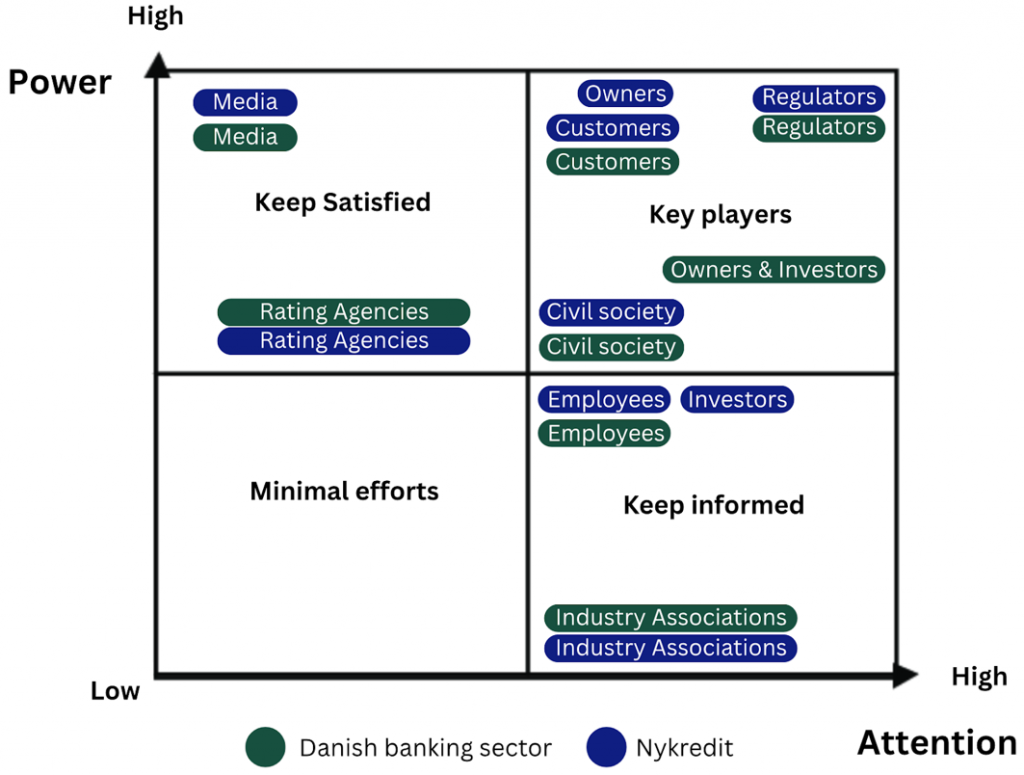
Our research found that stakeholders within the Danish banking industry hold diverse expectations regarding ESG actions. For Nykredit, stakeholders such as regulators, owners, civil society, and customers emerge as particularly influential, due to the bank’s ownership structure and customer-centric business model. 

Illustration 1: Power/Attention Matrix of Influence from Stakeholders on Nykredit and Peers 

ESG Integration and Institutional Pressures 

Nykredit, along with its peers, experiences significant regulatory pressures, reflecting strong coercive isomorphism. Regulations have increasingly formalized corporate governance processes, compelling banks to adopt consistent ESG standards. Alongside regulatory pressures, mimetic pressures – where institutions follow leading practices – have pushed Danish banks toward convergence in sustainability commitments. 

Yet, Nykredit stands apart by proactively integrating ESG responsibilities at the highest decision-making levels and through differentiated sustainability commitments. Rather than widespread ESG campaigns, Nykredit emphasizes targeted communication with key stakeholder groups, enhancing its responsiveness and reinforcing its leadership position among peers. 

Benchmarking ESG Leadership 

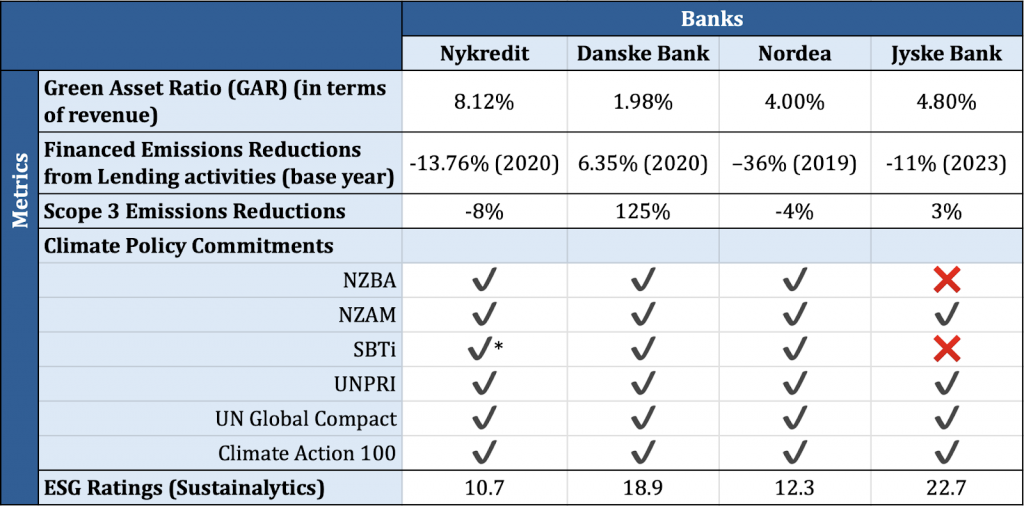
A comparative analysis against Denmark’s largest banks shows Nykredit’s proactive and strategic leadership. Nykredit’s strategic alignment with stakeholder expectations has not only concretized its ESG efforts but has also elevated the ambition and depth of these initiatives, positioning the bank strongly in addressing climate-related risks and enhancing overall resilience and reputation. 

Our findings indicate that conflicting stakeholder expectations are not fundamentally opposed but rather differ in terms of urgency, ambition, and pace. This nuanced understanding offers valuable insights for financial institutions aiming to align their strategies effectively with stakeholder expectations. 

Illustration 2: Benchmarking of Nykredit, Danske Bank, Nordea, and Jyske Bank 

*SBTi validated. 

Practical and Theoretical Implications 

For banks and financial institutions, our study highlights the importance of viewing competitors as ESG stakeholders whose strategies significantly influence sector-wide standards. It underscores how stakeholder-oriented ownership structures can foster ESG leadership, providing banks with practical insights for strategic planning and stakeholder engagement. 

On the theoretical front, the study challenges traditional assumptions in Institutional Theory about uniformity in ESG practices. It demonstrates how banks strategically leverage isomorphic pressures to enhance their sustainability profiles and competitive advantage. 

Conclusion: Strategic ESG as a Competitive Advantage 

Ultimately, our research underscores that aligning ESG strategies with stakeholder expectations transcends mere compliance or reputation management. Instead, it becomes a strategic enabler driving deeper sustainability commitments, competitive differentiation, and institutional leadership. Nykredit’s experience illustrates clearly how proactive engagement and alignment with stakeholders can fundamentally transform a bank’s ESG strategy, setting a benchmark for sustainable finance across the sector. 

About the Authors 

Prof. Kristjan Jespersen is an Associate Professor in Sustainable Innovation and Entrepreneurship at the Copenhagen Business School (CBS). Kristjan is an Associate Professor at the Copenhagen Business School (CBS). As a primary area of focus, he studies the growing development and management of Ecosystem Services in developing countries. Within the field, Kristjan focuses his attention on the institutional legitimacy of such initiatives and the overall compensation tools used to ensure compliance. He has a background in International Relations and Economics.  

Ida Marie Arends holds a MSc in General Management and Analytics with a minor in ESG, Metrics, Reporting, and Sustainable Investments from Copenhagen Business School (CBS). Ida works in Application Portfolio Management in e-Trading at Nordea Markets, where responsibilities include assessing and managing risks, application governance, and compliance of trading and sales applications. 

Oliver Daniel Koch holds a MSc in General Management and Analytics with a minor in ESG, Metrics, Reporting, and Sustainable Investments from Copenhagen Business School (CBS). Oliver works as an analyst in Institutions in Nykredit Markets, where responsibilities include overseeing Nykredit’s correspondence network in Denmark and internationally and relational work with institutional clients, mainly banks. 

Can Nudges Move Billions? Influencing Capital Allocation of Institutional Investors Towards Sustainable Infrastructure

vap.msc@cbs.dk · 01/07/2025 ·

By Prof. Kristjan Jespersen, Ann-Kathrin Stecklina & Helen Thiesemann

The transition to a sustainable, low-carbon economy requires not just technological advancement or policy alignment but substantial capital investments. Sustainable infrastructure has faced macroeconomic headwinds, while simultaneously governmental investments are decreasing. Hence, the role of private capital, particularly from institutional investors, has become increasingly critical to close the financing gap. A substantial mismatch between capital targeted and capital raised persists in the market, posing significant challenges to meet investment needs required to achieve the SDGs, combat climate change, and enable social improvements.

Sustainable infrastructure, as an asset class, presents multiple barriers due to its inherent complexity and associated risks, explaining the underinvestment in the sector. These challenges are further heightened by the risk-averse nature of institutional investors, whose decisions are shaped by fiduciary duties and a focus on market returns. This highlights the need for holistic approaches that address the cognitive limitations of institutional investors in order to increase capital allocation towards sustainable infrastructure.

A behavioural lens on sustainable finance

To date, most research has focused on how regulatory reforms and policy interventions influence the capital allocation decisions of institutional investors. As a result, this paper adopts an exploratory research design to investigate how behavioural economics, specifically Nudge Theory, can influence institutional investors to allocate more capital towards sustainable infrastructure investments (SII).


Nudges are subtle changes in the choice architecture that guide decision-making towards choices that improve lives and that of society at large, without restricting the freedom of choice. While nudging has been widely tested on individuals and retail investors, its application to institutional actors remains underexplored.


Empirical analysis
To bridge the research gap, semi-structured interviews with asset owners and managers across Europe have been conducted, while applying a deductive research approach to analyse the capital allocation of institutional investors under the lens of three theoretical frameworks: Nudge Theory, New Institutional
Economics, and the Behavioural Theory of the Firm. Based on these theories, the relevance and applicability of nudges among institutional investors is explored and how nudges can mediate the effects of cognitive limitations as well as institutional and intra-organisational constraints is investigated.

Key findings

Empirical findings reveal that cognitive limitations shape investment decisions, even in the institutional context. While many institutional investors aim to act rationally, their decisions are influenced by heuristics and biases, formal and informal rules, as well as standard operating procedures. Within the interviews, it became evident that behavioural interventions are already subconsciously utilised by asset managers and perceived to actively shape decision-making of asset owners, influencing their commitment towards SII. Nudges such as framing, priming, and Sustainable Finance Literacy (SFL) initiatives indicate a strong and promising influence, while default options and a small fee received
greater scepticism in their applicability due to the inherent difficulty of implementing such nudges. In consequence, nudges offer a promising yet underutilised avenue for asset managers to accelerate capital flow towards sustainable infrastructure.

However, their effectiveness remains contingent on the risk-return ratio, the institutional settings, and organisational context. Nudges were tested to effectively mediate the impact of cognitive limitations and biases present within institutional investors, while no matter how well designed, they cannot mediate fundamental institutional constraints but rather be understood as additional efforts in influencing the decision-making. Lastly, nudges indicate to mediate intra-organisational constraints by leveraging bounded rationality and reducing ambiguity around the asset class. Overall, nudges are not silver bullets but serve as an effective strategic intervention to influence institutional investors’ decision-making to allocate capital towards SII.

Implications for asset managers and policymakers

The research opens a new avenue for both scholars and practitioners by demonstrating how behavioural tools can bridge the gap between sustainability ambition and capital allocation. While structural reforms and incentives remain important, nudges provide a complement to institutional reforms.


For asset managers, the findings underscore the importance of tailoring communication strategies to the individual preferences of asset owners by emphasising distinct aspects of the investment option and aligning nudging mechanisms with fiduciary duties. Furthermore, trust and long-term relationships can be strengthened by employing social norm nudges and targeted relationship-building initiatives.


Furthermore, the study highlights that the effectiveness of nudges demands policy alignment to realign market dynamics and reduce barriers to sustainable capital allocation. The market must be stimulated through a unified set of sustainability definitions and ESG metrics, an inclusion of long-term sustainability objectives in the definition of fiduciary duty, and regulatory stability achieved through subsidy and tax regimes. Hence, while nudges can facilitate behavioural shifts, broader systemic reforms are essential to enable and sustain meaningful change.


In conclusion, this research provides empirical and theoretical insights into how behavioural interventions, in the form of nudges, can drive change in investment practices, enhance societal welfare, and mobilise private capital to close the substantial financing gap in sustainable infrastructure.

About the authors:

Prof. Kristjan Jespersen is an Associate Professor in Sustainable Innovation and Entrepreneurship at the Copenhagen Business School (CBS). Kristjan is an Associate Professor at the Copenhagen Business School (CBS). As a primary area of focus, he studies the growing development and management of Ecosystem Services in developing countries. Within the field, Kristjan focuses his attention on the institutional legitimacy of such initiatives and the overall compensation tools used to ensure compliance. He has a background in International Relations and Economics.  

Ann-Kathrin Stecklina works as a student consultant at Prokura, supporting strategy and operations projects with a focus on procurement and supply chain management. Ann-Kathrin has a background in broader management consulting and innovation management, while her experience in working at a social enterprise raised her passion about sustainability and impact-driven strategies. She is completing her Master’s degree in International Business at Copenhagen Business School (CBS), where she had the opportunity to study abroad in Canada to deepen her understanding of global markets and cross-cultural management. This thesis was written under the guidance of Professor Kristjan Jespersen, in collaboration with her thesis partner Helen Thiesemann.


Helen Thiesemann works as a student analyst at Copenhagen Infrastructure Partners (CIP), supporting Go-to-Market strategies within Investor Relations and Business Development. Her current work further reflects her interest in sustainable investments. Previously, she worked in management consulting as well as investment bank transformation. Helen is now completing her Master’s degree in International Business at Copenhagen Business School (CBS), where she had the opportunity to write her master thesis with her thesis partner Ann-Kathrin Stecklina under the guidance of Professor Kristjan Jespersen. Helen also volunteers at the AMES Foundation, a “for impact” organisation with the mission of making biodiversity scalable and profitable so that Africa becomes a safer place for animals.

  • « Go to Previous Page
  • Page 1
  • Page 2
  • Page 3
  • Go to Next Page »

Copyright © 2026 · Copenhagen Business School

  • Accessibility Statement
  • Privacy Policy
  • Cookies