

By Elisa Hugary, Jakob Wadel, Maximilian Styra, Camilla Feldmann, Anna Brusco and Prof. Kristjan Jespersen
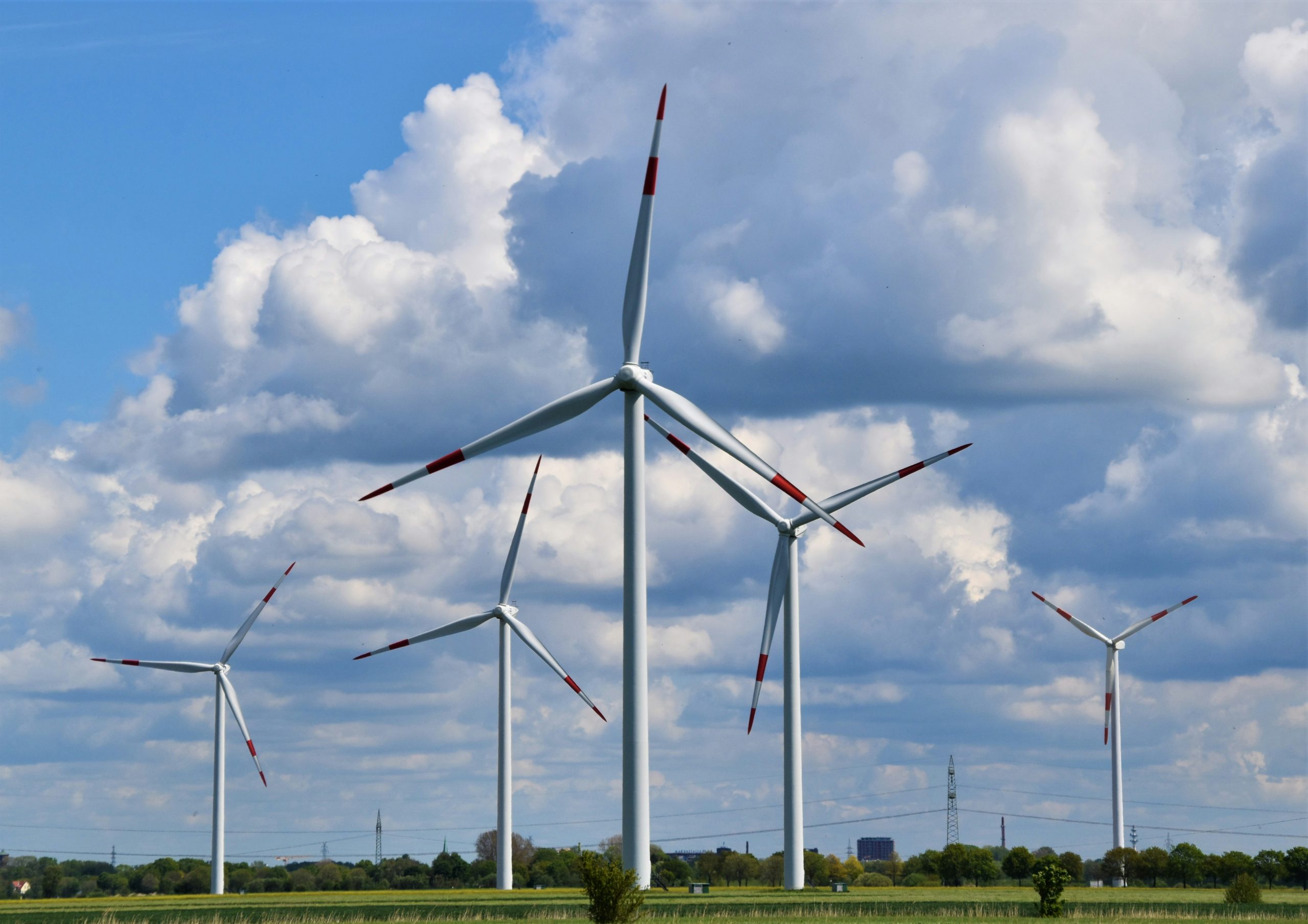
Offshore wind energy has become a cornerstone of Europe’s energy transition. Capital is flowing at scale, capacity is expanding rapidly, and the sector is widely regarded as one of the most promising sustainable investment opportunities available. Yet the story is more complicated than the capital deployment figures suggest. Offshore wind development generates real environmental pressures on marine ecosystems: underwater noise, seabed disturbance, bird collisions, and increased vessel traffic. These are not exceptional side effects. They are inherent features of how offshore wind farms are built and operated. In principle, such impacts are assessed through Environmental Impact Assessments (EIAs). In practice, EIAs function primarily as regulatory compliance tools. They are project specific, differ in scope and methodology across jurisdictions, and rarely allow meaningful comparison between projects. The result is that investors tend to engage with marine environmental impacts only when regulation forces them to. This raises a central question: how can environmental impacts be assessed in a way that is both ecologically meaningful and practically useful for investment decisions?
The limits of project level EIAs
EIAs contain extensive environmental information, but they are not built for comparability. Two offshore wind farms may generate similar environmental pressures while describing them using entirely different metrics, assumptions, and formats. From an investor’s perspective, this makes it nearly impossible to assess relative environmental risk across assets or portfolios. Interviews conducted for this research confirm what many practitioners already suspect: environmental impacts typically enter financial decision making only through regulatory channels. Biodiversity concerns may lead to permitting delays, additional mitigation requirements, or project redesigns, all of which carry direct financial consequences. But outside these regulatory triggers, environmental information remains largely disconnected from investment analysis. Closing this gap requires a more structured and consistent approach to assessing environmental impacts.
Thinking at the asset level
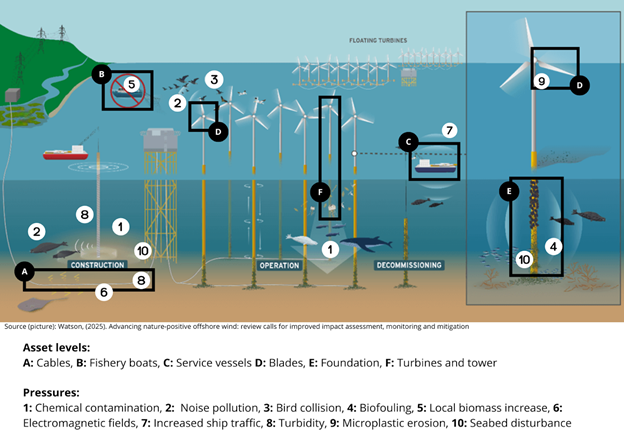
Environmental pressures do not arise at the “project level.” They originate from specific components and activities across the offshore wind lifecycle. Foundations, turbines, cables, and vessels each generate distinct pressures during construction, operation, and decommissioning. Adopting an asset level perspective makes it possible to identify recurring pressure patterns across offshore wind projects, even when individual EIAs describe them differently. When these cause-effect pathways are mapped systematically, a striking pattern emerges: a limited number of environmental pressures occur repeatedly across assets and lifecycle phases, and they are consistently supported by scientific evidence. This asset level mapping provides a clearer and more systematic understanding of how offshore wind infrastructure interacts with marine ecosystems.
Five recurring pressure categories
Across asset levels and lifecycle phases, five pressure categories emerge as both robust and material: bird collisions, noise pollution, seabed disturbance, vessel pressure, and water contamination. Each of these is generated by multiple assets and occurs across different stages of offshore wind projects. While they are partially addressed in existing regulation, they are not assessed in a standardised or comparable way. Identifying these recurring categories is a crucial step toward building a consistent environmental assessment framework.
From pressures to a comparable impact score
Translating environmental pressures into investment relevant information requires standardisation. This research develops a scoring mechanism for precisely this purpose: the Offshore Wind Environmental Impact Score (OWEIS). The logic is deliberately straightforward. Environmental pressures are first quantified using established models already commonly applied in EIAs. Because these impact values are expressed in different units and scales, they are then standardised to ensure comparability across pressure categories. Finally, the standardised values are weighted using the ENCORE scale according to their ecological materiality and aggregated into a single, transparent score. The OWEIS does not aim to replace detailed ecological analysis. Rather, it enables relative comparison across offshore wind assets, allowing investors to assess which projects are likely to face higher or lower environmental risk under comparable conditions.
What this means for investors
Environmental pressures become financially relevant through transition risk. Projects with higher environmental impacts face a greater likelihood of permitting delays, stricter mitigation requirements, reputational pressure, and future regulatory tightening. Each of these factors can affect project timelines, costs, and ultimately asset valuations. The reverse also holds. Projects with lower environmental impact profiles tend to be more resilient: less exposed to regulatory intervention, less prone to disruption, and better aligned with evolving sustainability expectations. From an investment perspective, this translates into more predictable cash flows and lower downside risk. By integrating asset level environmental data into due diligence and portfolio analysis, investors can move beyond compliance driven assessments and begin incorporating environmental risk more systematically into capital allocation decisions.
Bridging marine ecology and finance
Offshore wind is essential for decarbonisation. But its environmental footprint cannot be treated as an afterthought. Current assessment practices generate valuable ecological data, yet they fall short of what investors need: consistent, comparable information that can inform capital allocation. An asset level approach, combined with standardised scoring, offers a practical way forward. It does not resolve every tension between energy transition ambitions and marine conservation. But it does provide a foundation for more informed investment decisions and, ultimately, for a more honest accounting of what offshore wind development costs
About the Authors
Elisa Hugary is finalizing her MSc in People and Business Development at Copenhagen Business School. During her electives she took a minor in Building Organizations for Sustainable Futures, working closely with researchers for the Making Oceans Count project, which built the foundation for this blog post. Alongside her studies Elisa is working as a Junior Sustainability Consultant in an international logistics company where she supports sustainability reporting and initiatives.
Jakob Wadel is currently completing his MSc in Management at WU Vienna. During his exchange semester at Copenhagen Business School (CBS), he focused on consulting, management, and digital transformation, contributing to the Making Oceans Count project underlying this blog post. Alongside his studies, he has gained experience in finance and energy-related roles, including supporting investment analyses, developing controlling systems for solar projects, and contributing to financial planning. Currently, he is gaining further first-hand experience in Austria’s energy industry, working in an in-house consulting environment.
Maximilian Styra is currently completing his MSc in Management at WU Vienna, after earning his Bachelor’s degree in Business Administration from the University of Münster. During his Erasmus semester at Copenhagen Business School (CBS), he focused on the strategic integration of sustainability into business models and contributed to the Making Oceans Count project underlying this blog post. Alongside his studies, he has been working in real estate project development in Germany, where he explores how long-term value creation can be aligned with sustainability and environmental responsibility.
Camilla Feldmann is currently pursuing her MSc in Business Administration and Organisational Communication at Copenhagen Business School (CBS). Alongside her core programme, she has chosen the International Business and Society (IBS) profile, where she has focused on transformation, sustainability, and international collaborations and responsibilities. Through her studies, Camilla has developed a strong interest in how businesses navigate complex societal challenges and balance commercial objectives with sustainable and responsible practices in a global context.
Anna Brusco is in the final semester of her MSc in Sustainability Management at the University of Southern Denmark. During her electives semester at Copenhagen Business School (CBS), she focused on sustainable investing and responsible business, contributing to the offshore wind consulting project featured in this blog post. She is currently an ESG Data Intern at Matter, working with sustainability data for investors. Her master’s thesis explores geospecific data integration in sustainable finance.
Prof. Kristjan Jespersen is an Associate Professor in Sustainable Innovation and Entrepreneurship at the Copenhagen Business School (CBS). Kristjan is an Associate Professor at the Copenhagen Business School (CBS). As a primary area of focus, he studies the growing development and management of Ecosystem Services in developing countries. Within the field, Kristjan focuses his attention on the institutional legitimacy of such initiatives and the overall compensation tools used to ensure compliance. He has a background in International Relations and Economics.