

By Prof. Kristjan Jespersen, Justus Claudius Ernst and Áron Radványi

Today’s global environment is increasingly volatile, uncertain, complex, and ambiguous (VUCA). This heightened uncertainty underlines the importance of organizational resilience—how companies prepare for and respond to adverse events. Frequent crises in the 21st century highlight severe consequences when disruptions occur in our fragile and interconnected socioeconomic systems. Companies have a dual responsibility: minimize their contributions to disruptions and mitigate their impacts on their own operations.
The Corporate Sustainability Reporting Directive (CSRD) mandates companies to perform Double Materiality Assessments (DMA). These assessments help identify and report impacts, risks, and opportunities (IRO) related to sustainability. Additionally, CSRD requires businesses to disclose how resilient their strategies and business models are. Despite these regulations, many companies lack a clear method for integrating DMA into resilience-focused strategies.
DMA as a Strategic Learning Loop
Our research found that DMA, when used strategically, becomes more than a mere reporting requirement—it transforms into a catalyst for continuous learning, innovation, and resilience. Our findings are based on 15 semi-structured interviews with representatives from 13 C25 companies and two sustainability advisory firms. Using a resource-based view and the dynamic capabilities framework, we analyzed the data to understand DMA’s strategic potential for organizational resilience.
Instead of a one-off annual exercise, strategically applied DMA creates a continuous learning loop. Regularly reassessing environmental, social, and governance (ESG) issues and stakeholder concerns leads to ongoing improvements. Each assessment cycle provides insights that inform decision-making, helping companies adapt proactively to emerging sustainability trends and stakeholder expectations. This process institutionalizes a habit of learning and adaptability within organizations.
DMA as a Strategic Knowledge Asset
Insights gained through DMA become strategic intangible assets. By understanding stakeholder priorities, environmental risks, and social impacts deeply, companies generate knowledge that fulfills the VRIO criteria:
- Valuable: Helps identify and mitigate risks.
- Rare: Unique due to specialized DMA methods.
- Inimitable: Built on unique stakeholder relationships and proprietary data.
- Organized: Fully integrated into the company’s operational systems.
These insights provide competitive advantages. Sustainability practitioners can leverage DMA to generate proprietary intelligence, such as early identification of environmental risks or emerging consumer concerns ahead of competitors.
DMA Enhancing Dynamic Capabilities
Treating DMA strategically strengthens a company’s dynamic capabilities—its ability to adapt rapidly to change. Our study found that firms deeply engaged with DMA:
- Enhance their sensing abilities by scanning continuously for risks and opportunities.
- Improve their seizing capabilities by integrating DMA insights into business operations.
- Strengthen their transforming abilities by adjusting operations or products based on new sustainability insights.
Companies that approach ESG as merely a compliance checklist often lack the agility required to respond to new challenges. Conversely, those strategically leveraging DMA foster cross-departmental collaboration and innovation, increasing their overall resilience.
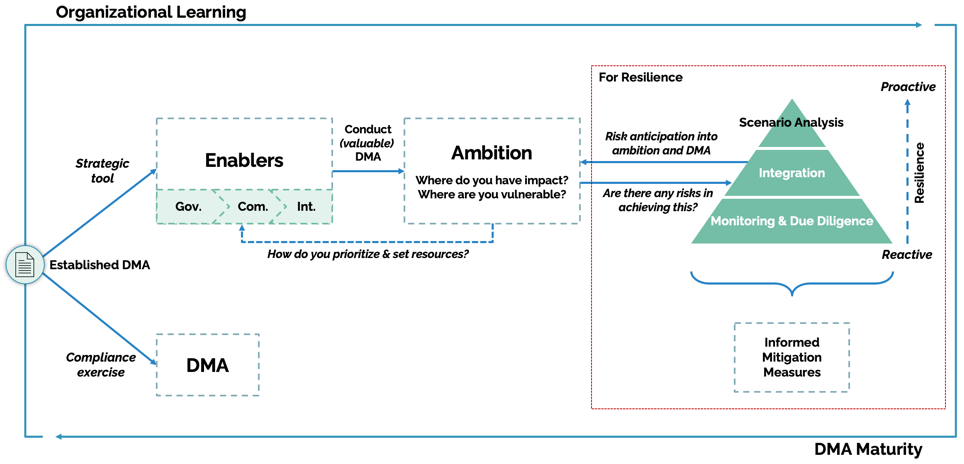
The Integrated DMA Ecosystem
Embedding DMA into core corporate processes further enhances organizational resilience. Instead of being confined to sustainability teams or annual reports, DMA becomes integrated into broader corporate strategy, risk management, governance, and stakeholder engagement. This holistic integration ensures organization-wide alignment in monitoring and responding to ESG issues, enabling proactive identification and mitigation of risks.
For example, early detection of supply chain vulnerabilities or community concerns through DMA prompts preemptive actions, cushioning potential crises. A proactive approach involving cross-functional workshops, regular updates to the materiality matrix, and executive goals linked to sustainability outcomes transforms companies from reactive to proactive entities.
Conclusion
Strategically embracing DMA shifts the focus from mere compliance to building long-term organizational resilience. Integrating DMA into business strategy and routine learning enables companies not just to meet regulatory requirements but also to proactively anticipate and adapt to sustainability challenges. This resilience-focused approach ultimately unlocks sustained competitive advantages in an increasingly volatile world.
About the Authors
Prof. Kristjan Jespersen is an Associate Professor in Sustainable Innovation and Entrepreneurship at the Copenhagen Business School (CBS). Kristjan is an Associate Professor at the Copenhagen Business School (CBS). As a primary area of focus, he studies the growing development and management of Ecosystem Services in developing countries. Within the field, Kristjan focuses his attention on the institutional legitimacy of such initiatives and the overall compensation tools used to ensure compliance. He has a background in International Relations and Economics.
Justus Ernst recently completed a Master’s degree in Accounting, Strategy and Control at Copenhagen Business School (CBS), alongside a CEMS Master’s in International Management. During his studies, he worked at Jabra, focusing on pricing and commercial excellence. In September, he will join Valcon as a Graduate Management Consultant.